


Q&A with artist John Armstrong
We’re delighted to share a Q&A with John Armstrong about his journey as an artist, the experiences that have shaped his work, and the deeply personal inspiration behind his Bee in the City Hero sculpture. From early experiments with pastels to rediscovering painting during lockdown, John’s story is one of persistence, growth, and connection.
Can you tell us a little about yourself and your journey as an artist?
From early experiments with pastels to sold-out exhibitions and a deeply personal commission for Bee in the City, this artist’s journey is one of courage, rediscovery, and profound connection. With a background in history and years devoted to family and public service, art has remained a constant undercurrent — sometimes quiet, sometimes urgent — but always essential.
We sat down to talk about his creative journey, the inspiration behind his Hero bee sculpture, and the powerful personal story that shaped this project.
Can you tell us a little about yourself and your journey as an artist?
I became interested in art after leaving school in the early 1990s. I used to visit the Coromandel region quite frequently and found myself wanting to express something of the joy I felt when I visited that beautiful region. I had also seen some work by artists in the area and eventually summoned the courage to give it a try.
I began by using pastels, which are a cheap and easy-to-use medium for beginners. I very quickly found myself fascinated with all aspects of art-making: the discovery of a strong innate preference for certain colours and certain kinds of lines (my artistic handwriting), and the magic of producing the illusion of three-dimensional space. I gave all my early work away to patient friends and family, but after three or four years decided that I should try showing my work in public.
I put a few pieces on a table at the Te Kauwhata A&P Show in about 1997 and, to my amazement, sold one (I think I charged $40). This was immensely encouraging, and over the following years art became an increasingly important part of my life.
In 2003, I went to university as an adult student but continued to paint (by then I had switched to oil paint). In 2005, I had my first gallery exhibition at Artspace Gallery in Hamilton, where I sold all but one of the paintings I showed. In 2009, our son Ruben came along, and for the next few years my art well and truly took a back seat.
I graduated from Waikato University with a PhD in New Zealand history in 2013 and moved to Wellington, where I worked as an historian at the Office for Treaty Settlements. I barely painted at all for the next few years, but when we were given 48 hours’ notice of the first COVID lockdown, I went out and bought some art gear, anticipating that I might have a bit more spare time.
When I started painting again, it was a complete revelation. Despite not having painted much at all for close to ten years, it felt like I had never stopped. It was as if my work and style had been bubbling away in the background, and when I began to paint again the work I produced felt much more sophisticated and more significant. I think the life experiences I had had as a parent, as a student, and as an historian working in the incredibly rewarding Treaty settlement process all came out when I resumed painting, and I have never looked back.
In 2022, I was walking through Wellington one lunchtime and, on a whim, went into the Exhibitions Gallery of Fine Art, where I had a conversation with the owner, Ron Epskamp. I then emailed him some pictures of my recent work and (again) to my amazement he agreed to put on an exhibition. Since then, I have had four exhibitions with Ron and Sharon. I’ve sold 26 paintings through them now, which has been incredibly affirming.
However, by far the biggest reward has been the many connections I’ve made with people through my art and through the gallery. Art is a notoriously difficult thing to define, but for me one of its most important characteristics is its ability to generate conversations about things we might not otherwise talk about. Art has enriched my life immeasurably, to the point that I now can’t really imagine functioning without it.
Why did you want to be involved with Bee in the City and painting this Hero sculpture?
At the end of 2025, my father was diagnosed with terminal cancer. He was admitted to Waikato Hospital, and for the next ten weeks I spent most of my time with him. However, because both my brother and I live in Wellington, it became increasingly difficult for us to spend as much time with him as we wanted.
Eventually, the hospital staff arranged for Life Flight to transport Dad and me down to Wellington Hospital so that we could be with him at the end of his life. I will always be grateful for the incredible service we received from the people at Life Flight. When Ron mentioned that there was an opportunity to support them through my art, I jumped at the chance.
What message or feeling are you hoping the Hero sculpture will convey to the public?
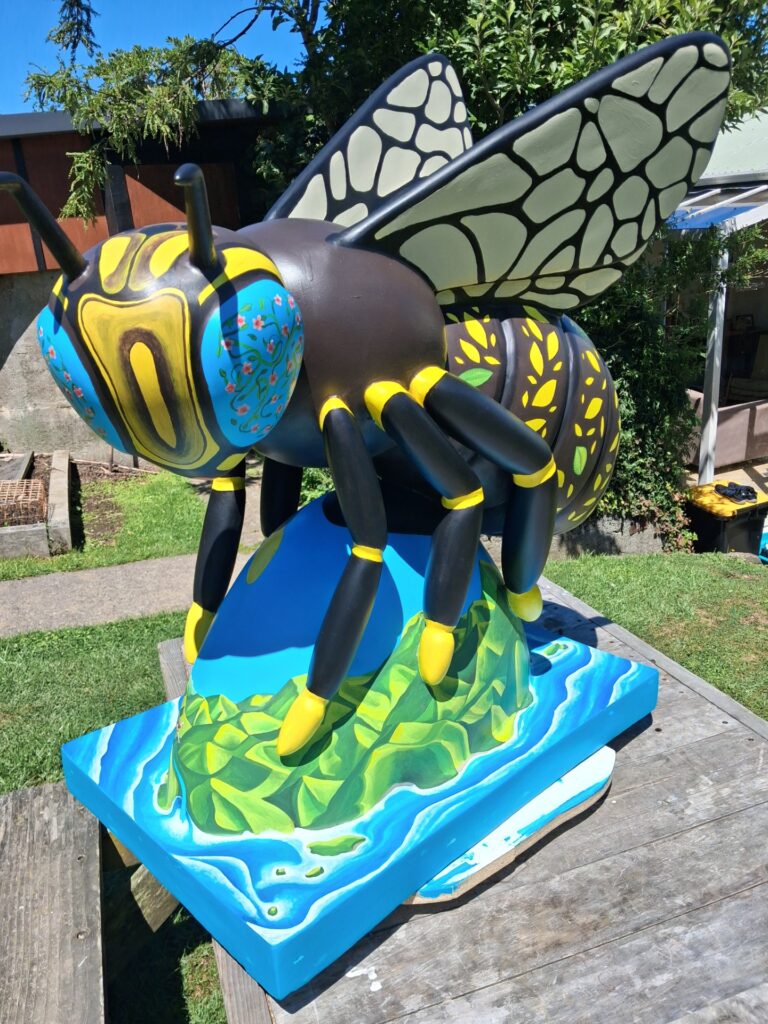
Over the years that I’ve made art, my sense of wonder at the natural world has only increased. For this reason, I wanted to keep the bee looking more or less like a bee – they are beautiful and miraculous and weird enough (they have five eyes!) without me getting in the way.
I’ve tried to accentuate this sense of wonder by painting my bee hovering hugely over an island landscape. I guess I’m hoping that my sculpture might encourage people to reconsider the significance of nature – to take a closer look next time they see a real bee.
That might sound like a modest goal, but I worry that many of us have become quite detached from the environment around us. For me, some of the most profound moments of connection and contentment come from really looking at things as seemingly ordinary as a leaf, a sunset, or a piece of driftwood.
How do you approach painting a sculpture, and how does it differ from your usual mediums?
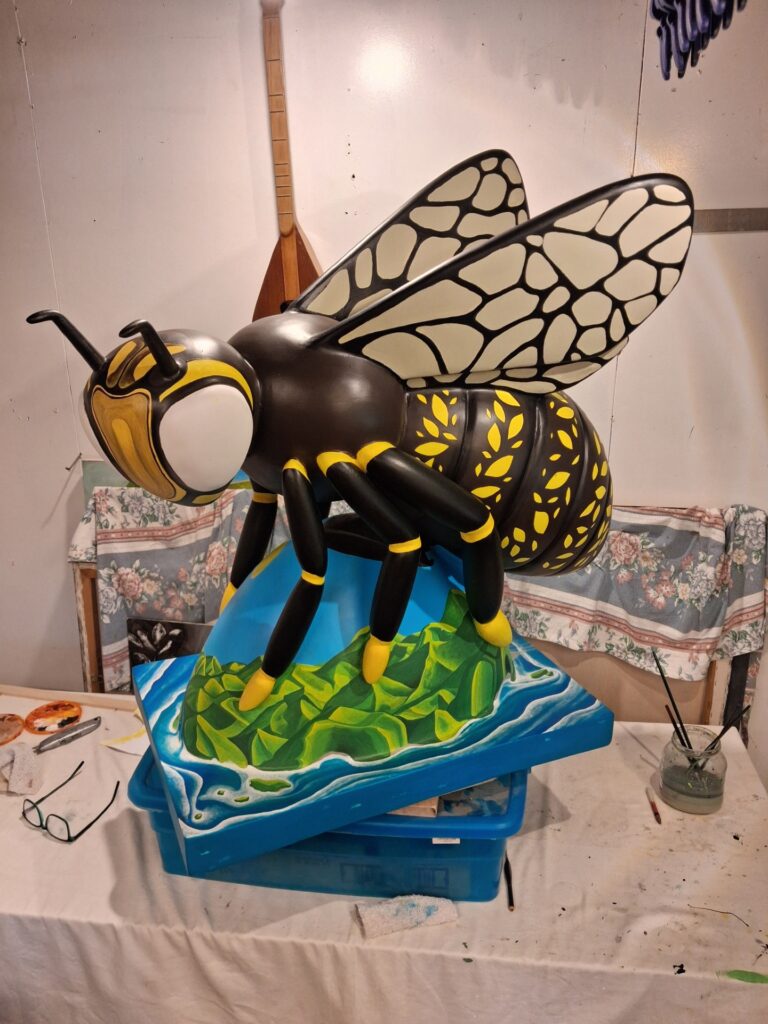
I’ve never painted a sculpture before, so it has been a very steep learning curve. At one level, it’s just physically awkward, so I’ve had to learn how to paint while contorting myself into odd shapes.
It has also required the use of a different kind of paint, which dries much faster than the oils I’m accustomed to and doesn’t really allow me to use many of the blending and shading techniques that I’ve developed over the years. While this has felt limiting at times, making it work has required me to develop my physical skills, which I think has helped me to grow as a painter.
The other difference is that I generally don’t plan my paintings out much. I usually just start making a mess and then respond to whatever happy accidents occur. I didn’t want to take this approach with the bee, as the stakes would be a bit too high if it failed (which it does sometimes). As a result, I planned this out a bit more than I usually would, although there have still been some nice accidents along the way. Overall, I’ve thoroughly enjoyed working on this project.
How do you hope people will interact with or respond to your sculpture?
I have included a little optical illusion in my sculpture that I hope people will enjoy discovering.
Thank you, John, for sharing your story and your work with us.
.

Bee in the know
Be part of the buzz! Subscribe to our eNewsletter for the latest trail updates, artist reveals, and exclusive behind-the-scenes news.
Please read our Privacy Notice which includes details about how we process personal data, how to exercise your privacy rights and how to opt out of email marketing.
I agree that I am signing up to receive regular newsletter communications from Life Flight.